
Do You Need a Golf GPS Device If You Already Use a Rangefinder?
Explore the benefits and differences of a golf GPS device versus a rangefinder to optimize your game strategy and shot accuracy on the course.
GPSRANGEFINDERS
Golf Tech Buzz Editorial Team - Led by AJ “Buzz” Eichman
5/11/20267 min read
If you’re like me, always tinkering with gear and hunting for that edge on the course, you’ve probably asked yourself: do I really need both a golf GPS device and a rangefinder? I mean, if you’re already dialing in your distances with a laser rangefinder, what’s the point of adding a GPS device to your bag? Well, here’s the deal—I’ve been there, tested both, and found out where each tool shines (and where they don’t). Let’s break it down so you can make a smart call and maybe drop a better shot or two this weekend.
Modern golf tech keeps evolving, and understanding how different systems work together is a huge part of building a smarter setup. A strong Golf Technology Guide can help golfers understand how GPS devices, rangefinders, launch monitors, and tracking systems all fit into modern course management and shot strategy.
Quick Verdict
Rangefinders give you pin-point laser accuracy to a specific target but need clear line-of-sight.
Golf GPS devices provide a full hole overview including hazards and green layouts, working even when you can’t see the target.
Using both can be a killer combo for course management and shot strategy—if you don’t mind carrying extra gear.
For casual players or folks on a budget, sticking to one device usually covers your bases just fine.
What Is a Golf GPS Device and How Does It Work?
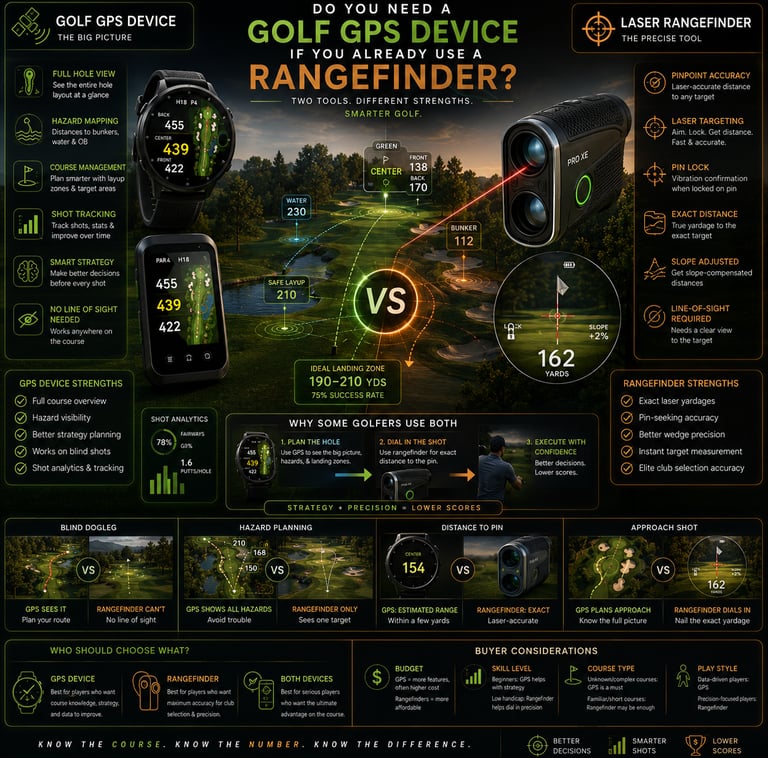
Imagine having a little caddie in your pocket or on your wrist that knows the layout of every hole on the course from a satellite’s eye view. That’s your golf GPS device—using satellite signals and preloaded course maps to give you distances to the front, middle, and back of the green, plus hazards and layup spots. Think of it as your virtual course planner, giving you bird’s-eye info at a glance.
The magic here is it doesn’t matter if you can see the flag or not—it’ll still tell you how far you are from key points. Plus, many models boast extras like shot tracking, scorecards, and stats. Just keep in mind, those distances are estimates based on mapping, not live laser readings.
Golfers looking for the strongest wearable and handheld options should also explore Best Golf GPS Devices to compare modern GPS watches, handheld systems, and advanced golf navigation tools.
What Is a Rangefinder and How Does It Work?
Now, a rangefinder is the sniper on your bag. It zaps a laser beam at a specific target—the pin, a bunker edge, or a tree—and calculates the distance based on the time it takes for the laser to bounce back. Super accurate, usually within a yard. But you’ve got to get a clear shot at the target, which means no obstructing trees or giant hills in the way.
It’s precise, instant, and laser-focused on what you want. The downside? It’s limited if visibility is poor or you’re looking over a tricky dogleg. It’s strictly a distance-to-target tool with no extra fluff.
Golfers comparing premium laser systems should also review Best Golf Rangefinders to better understand how stabilization, slope technology, and optics differ between models.
Key Differences Between Golf GPS Devices and Rangefinders
I like to think of these two as different tools for different jobs. Golf GPS devices are your strategy buddy, giving you the bigger picture. Rangefinders are your execution tool, nailing down that exact distance when you take your shot.
Accuracy: Rangefinders usually beat GPS devices for precision since they use laser measurement, while GPS distances are approximations.
Line-of-Sight: Rangefinders need it; GPS does not.
Features: GPS devices often include course layouts, scorekeeping, and shot history; rangefinders focus on distance.
Usability: GPS devices work great in challenging visibility or unfamiliar courses; rangefinders shine in clear conditions and for pinpoint shots.
If you want a deeper breakdown between these technologies, How Golf Rangefinders Work: Laser vs GPS Technology explains where each approach performs best during real-world play.
Advantages and Limitations of Rangefinders
Rangefinders excel when you want to know the exact distance to the pin or hazards in straightforward conditions. If you’re eyeing a tucked pin behind a tree or a narrow strip of fairway, this is your go-to. Players who crave accuracy for club selection swear by them.
But they have limitations. Line of sight is king here. No clear view? No distance. Weather and lighting can mess with the reading, and sometimes aiming at a tiny flagstick gets tricky. Also, rangefinders don’t tell you about other hazards or green layouts, so you’re guessing more on course strategy.
Golfers comparing premium laser units may also find Bushnell Pro X3 vs Nikon Coolshot Pro 3 useful since both devices approach stabilization and targeting differently.
Advantages and Limitations of Golf GPS Devices
Golf GPS devices are the all-in-one tool for course knowledge. They light up the full hole layout, give you distances to hazards, doglegs, and different parts of the green—even if the pin is hidden. On unfamiliar or complex courses, this bird’s-eye view is invaluable.
Plus, GPS watches or handheld devices often pack features beyond distance: shot tracking, scoring, strokes gained stats, and tee management. If you like digging into data post-round, you’ll appreciate that.
However, don’t expect laser-style pinpoint accuracy. GPS distances are estimates, usually within a few yards, but they don’t replace the laser’s exactness. Also, battery life varies, and some devices need course downloads or updates before you play.
Golfers focused heavily on navigation and strategy should also check out How GPS Devices Help With Course Management and Shot Strategy since GPS systems offer far more than just basic distance readings.
Can Using Both Devices Improve Your Game?
Here’s where some guys get excited and others raise an eyebrow. Using a golf GPS device alongside a rangefinder? It’s like having your cake and eating it too—but carry the plate carefully.
The GPS device gives you the full course picture, so you know risks, carry distances, and safe zones. Then, when you get to your shot, the rangefinder zeroes in with laser accuracy to the pin or specific targets. It’s precision meets strategy.
I’ve seen guys improve their course management and lower scores by using both—especially in longer or tougher rounds. But if you’re more casual or budget-conscious, the combo might be overkill.
Buyer Considerations: Choosing Based on Budget, Skill, and Course Type
Figuring out your ideal golf distance measuring tool boils down to three big questions:
What’s my budget? GPS devices can be more feature-packed but pricier upfront and over time with subscriptions. Rangefinders are more affordable but less multifunctional.
What’s my skill level? If you’re working on precise club selection and need true distances, a rangefinder is valuable. For beginners or intermediate players, a GPS device might provide all the guidance you need.
Where do I play? Know your courses. If you regularly face complex layouts or courses you don’t know well, a GPS device helps with strategy. If you play mostly the same familiar course, a rangefinder might do just fine.
Golfers deciding between wearable systems and dedicated laser units may also benefit from reading Garmin Watch vs Rangefinder: Which is Best for Your Golf Game? before buying into one ecosystem.
Common Mistakes With Golf GPS Devices and Rangefinders
If I had a nickel for every time I’ve seen these screw-ups, I’d be smoking cigars in a private locker room somewhere:
Assuming GPS and rangefinder give the exact same info — they don’t. GPS gives estimates and broad overviews, rangefinders give pinpoint distance.
Using a rangefinder blindly without considering hazards or course layout that GPS would highlight.
Expecting laser-level precision out of GPS devices in every situation.
Forgetting to maintain or charge devices, especially when relying on GPS watches for multiple rounds.
Using rangefinders without learning correct aiming techniques, resulting in missed readings.
Overlooking the tactical advantage of using both tools together when appropriate.
If you avoid these, you’ll get the best from both worlds.
Frequently Asked Questions
Can I use a golf GPS device and rangefinder together effectively?
Absolutely. Combining a GPS device’s hole overview with a rangefinder’s pinpoint laser accuracy can give you a strategic edge, especially on tricky courses.
What are the key differences between a golf GPS device and a rangefinder?
Rangefinders use laser pulses for precise distance to a specific target but require a line of sight. GPS devices use satellite data and course maps to provide distances to multiple points without needing to see the target.
Is a golf GPS device or rangefinder more accurate for distance measurement?
Rangefinders are typically more accurate, offering laser-precise distances within a yard. GPS devices provide estimated distances based on mapped data, usually within a few yards.
What are the benefits of having both a golf GPS device and rangefinder?
Having both means you get broad situational awareness plus exact distance readings, improving course management and shot execution.
Are golf GPS devices and rangefinders legal for tournament play?
Most tournaments allow rangefinders without slope features enabled. GPS devices are allowed with restrictions—always check local rules before competition.
How do weather and terrain affect the performance of GPS devices and rangefinders?
Rangefinders need clear line of sight; rain, fog, or hills can block laser signals. GPS devices are less affected by weather but rely on GPS signal quality, which can suffer in heavy tree cover.
What factors should I consider when choosing between a GPS device and a rangefinder?
Budget, your skill level, course familiarity, need for additional features like score tracking, and whether you prioritize precision or overview should guide your choice.
Do golf GPS devices require any setup or course downloads before use?
Many do, especially handheld units or watches. It’s smart to update and download courses before your round to get the best experience.
Final Thoughts: Do You Need Both?
If I’m being honest, most golfers don’t need to carry both a golf GPS device and a rangefinder. Each tool is solid on its own and suited to different styles and playing environments. Rangefinders bring laser-sharp accuracy when you want to dial in exact shots, while GPS devices are like having a mini caddie showing you the course map and hazards at a glance.
But here’s the thing—if you’re the type who’s serious about course management, plays a lot on unfamiliar or challenging courses, and doesn’t mind a little extra tech in your bag, pairing them can be a game-changer. I’ve logged wins and better scores using both, no doubt.
For casual players or folks on a budget, pick the device that fits your style. Rangefinder for precision, GPS for breadth and convenience. Either way, you’ll have a smarter walk around the course. And that’s what it’s all about—making better decisions, having more fun, and maybe knocking a few strokes off your handicap while you’re at it.
© 2026 GolfTechBuzz. All rights reserved.
Golf Tech Buzz
Performance Through Data
Practical guides, real-world setups, and unbiased comparisons for golfers building smarter practice environments.
General Inquiries: