

GPS Watch vs Handheld GPS: Which Works Better on the Course?
Explore how a GPS watch compares to handheld GPS devices on golf courses, focusing on accuracy, convenience, and battery life for better gameplay.
GPS
Golf Tech Buzz Editorial Team - Led by AJ “Buzz” Eichman
5/11/20267 min read
Every golfer worth their tees knows that knowing your yardage isn't just a nice-to-have — it can make or break a round. These days, we’ve got gadgets galore claiming to improve your game by helping with golf course navigation. But when it comes down to it, does a GPS watch or a handheld GPS device truly deliver better bang for your buck on the course? I’ve been in winter leagues, played in some sweaty practice rounds, and yes, busted a few devices myself to find out.
Here’s the deal: GPS watches flex convenience with quick, glanceable info on your wrist, while handheld devices usually sport bigger screens loaded with more course details. They both tap into satellites to get you distances, but your choice depends on your style, patience with tech, and how much gear you want strapped on. Golfers trying to understand where GPS systems fit into the broader world of modern golf tech should also explore the Golf Technology Guide for a deeper breakdown of distance-measuring devices and performance tools.
Quick Verdict
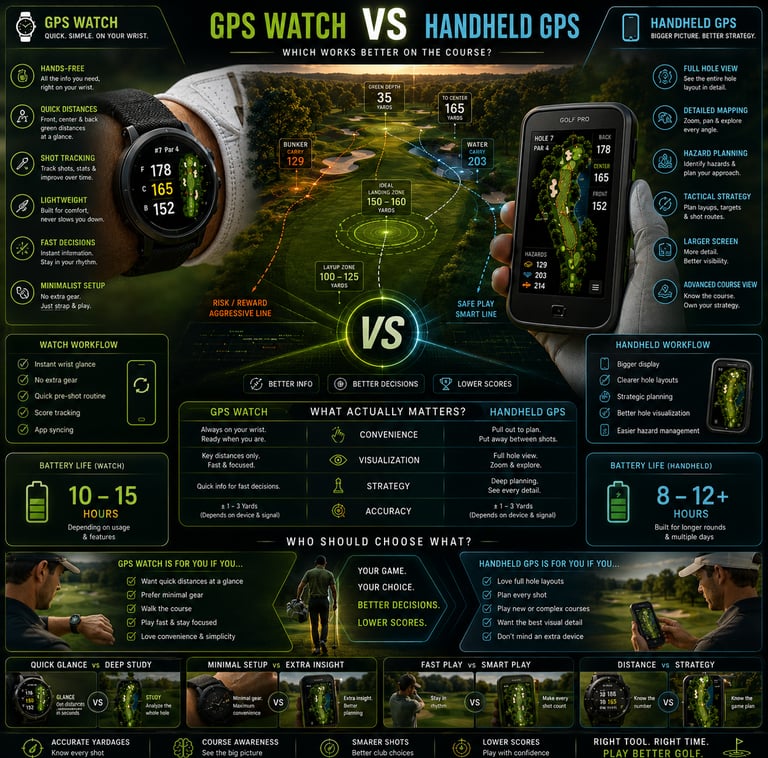
GPS watches are perfect for players who want minimal gear and quick access to distances right on their wrist.
Handheld GPS devices shine when you need detailed course maps and don’t mind carrying an extra gadget.
Battery life leans in favor of handhelds, especially for long days or multiple rounds.
Accuracy is pretty comparable but can wobble depending on the quality of the device and how open the course is to satellite signals.
How Golf GPS Technology Works
Let’s cut the fluff—both GPS watches and handheld devices rely on satellite signals orbiting over Earth. These satellites ping your device, which then calculates your position on the course, showing distances to the green, hazards, and sometimes even doglegs. The raw tech is similar for both; differences come down to physical design and interface.
Accuracy can hinge on the GPS chipset inside and how well your device keeps its signal lock. Open courses with little tree cover or tall buildings help, but areas with heavy canopy or hills can throw off readings no matter your device. Both device types come preloaded with course maps, but updates might need a sync with a smartphone or internet.
Golfers wanting a closer look at how satellite-based systems calculate distances should also read How Golf GPS Works: A Comprehensive Guide since understanding the underlying technology helps explain why some devices perform better than others.
Key Features of GPS Watches
If you’re a minimalist who values convenience without any shlep, the GPS watch is your buddy. Strap it on and it’s there for every swing, no extra pockets or hands needed. They’re lightweight and discreet—great for not slowing your game down.
These watches focus on delivering easy-to-read info with minimal taps—yardages to front, center, and back of greens, plus hazards when available. The best ones even track your swing stats, keep score, and sync with golf apps so you can analyze rounds later.
Portability is where watches win. No fumbling for a device, no breaking concentration. It’s all about hands-free ease.
Golfers comparing premium wearable systems should also check out Best Golf GPS Devices since modern GPS watches now offer advanced tracking, AMOLED displays, and detailed course management tools.
Key Features of Handheld GPS Devices
Now, if you want a bit more detail without relying on your smartphone, handheld GPS devices are the way to go. They sport bigger screens, letting you zoom in on hole layouts, see hazards clearly, and get a more strategic look before lining up shots.
Some models come loaded with touchscreen controls, allowing easier navigation through different holes or course settings. It’s like having a little caddie in your bag who likes big stats and maps.
The downside? They add weight and you’ve got to keep them accessible, which can be annoying for folks used to traveling light.
Comparing Accuracy and Reliability
If I’m being honest, GPS accuracy isn’t a slam dunk either way—it boils down to the device’s chipset and satellite reception. I’ve seen guys swear by handhelds for miles, but their watches gave almost identical results. Sometimes, the bigger screen makes a difference psychologically, helping plan shots better, but distance accuracy usually stays in the same ballpark.
Reliability earns bonus points for handhelds, especially those with beefier batteries that don’t quit mid-round. Watches can struggle after 4-6 hours on the course, which might mean carrying a charger or switching devices if you’re hitting 36 holes.
Golfers interested in how GPS precision impacts club selection and strategy may also benefit from reading Understanding GPS Accuracy in Golf GPS Devices before choosing between wearable and handheld systems.
Usability and Convenience on the Course
Hands down, watches win on convenience. You don’t have to break your stance, pull out a device, or worry about dropping it in the rough. It’s right there on your arm with minimal interaction, so you can keep your pre-shot routine tight.
Handheld devices, however, deliver value when you want to scan holes or hazards beforehand. You can spend a minute planning where you want to land the ball because the bigger display shows the whole picture clearly.
If you’re a casual player or someone who likes to keep it simple, the watch’s ease of use is a solid advantage. For the data nerds or players who strategize every shot meticulously, handhelds can be worth the extra steps.
Golfers deciding whether they should carry both GPS and laser technology may also want to review Do You Need a Golf GPS Device If You Already Use a Rangefinder? since many players eventually combine both systems for strategy and precision.
Battery Life Considerations
Nothing kills vibe faster than a dead device when you need it most. Handheld GPS devices generally pack larger batteries — they’re bigger gadgets after all — and many can last 8-12 hours or more. That’s easily enough to cover a full day at the course or back-to-back rounds.
GPS watches are constrained by size, so battery life often falls between 10-15 hours depending on usage but can drain faster if you’re using advanced tracking features or connecting to apps. If your game involves walking long courses or playing tournaments, a handheld might keep you powered longer.
Buyer Tips: Choosing the Right Golf GPS Device
Here’s the shortcut: Think about how you play and what annoys you most. If lugging gear isn’t your thing and quick looks are your jam, a GPS watch will do the trick. Look for one with decent battery life, a clear display, and preferably preloaded with courses you play.
If you love diving deep into course details, want larger displays, and don’t mind packing an extra device, a handheld GPS is worth considering — just make sure it’s rugged and reliable.
Budget’s a big factor too. Watches can be pricier for the feature-rich versions, and handhelds vary widely. But neither type needs to break the bank — plenty of great mid-tier options deliver solid info without bells and whistles.
Common Mistakes Golfers Make When Choosing GPS Devices
Assuming handheld GPS devices are always more accurate without checking specific models. Quality varies more than size.
Ignoring battery life differences—this can spoil a long day out if your device conks out at the worst time.
Overlooking how much extra gear you want to carry. Convenience counts more than people think.
Failing to test ease of use on a device before buying. A confusing interface can distract more than it helps.
Buying based on brand name alone instead of matching features to your actual playing style and needs.
Expecting devices to perform identically regardless of course environment — thick woods and hills can throw GPS off for any device.
Frequently Asked Questions
Which device provides more accurate distance measurements on the golf course?
They’re generally comparable, but performance depends on the device’s GPS chipset and how open the course is. Handhelds sometimes edge out in tricky environments due to better antenna placement, but in most cases, a quality GPS watch will do.
How long does the battery last on GPS watches compared to handheld GPS devices?
Handheld GPS devices usually offer longer battery life—up to 12 hours or more—while GPS watches typically last 10-15 hours on a single charge, depending on usage.
Are GPS watches suitable for all skill levels of golfers?
Absolutely. They’re user-friendly and provide essential distance info that benefits beginners to pros alike.
Can handheld GPS devices display detailed maps and course layouts?
Yes, that’s one of their biggest perks. They often have bigger screens showing hole layouts, hazards, and distances, helping with strategic shot planning.
Is it necessary to have a smartphone connection with these GPS devices?
Not mandatory. Most golf GPS watches and handhelds come with preloaded courses and work independently, though smartphone syncing can help with course updates and tracking performance stats.
What are the setup requirements for using GPS watches and handheld GPS on the course?
Minimal. Usually, just charge the device, download any necessary updates, and you’re good to go. Some devices require pairing with a smartphone app for course downloads or software updates.
How do weather and landscape affect GPS accuracy in golf devices?
Dense tree cover, tall buildings, hills, or heavy weather can interfere with satellite signals, causing less accurate readings regardless of device type.
Are there significant price differences between GPS watches and handheld GPS devices?
Prices vary across brands and feature sets, but generally, advanced golf GPS watches can be pricier than simpler handheld models. It pays to shop around based on the features you actually need.
Conclusion
Look, both GPS watches and handheld GPS devices will get you the yardages you need to navigate the course smarter. If you’re the player who wants to keep it light and have instant info at your wrist, a GPS watch is the way to go — easy, efficient, and hands-free. But if you’re the guy who likes to nerd out over hole layouts and planning every shot, and you don’t mind lugging an extra unit, handheld GPS devices offer a more detailed perspective.
Battery life and screen size often tip the scales, so weigh those factors when picking your sidekick for the course. At the end of the day, it’s about what fits into your game, your gear bag, and your personality. Keep it real, avoid gimmicks, and trust what works out there when the stakes and the cigars come out.
Golfers still deciding between laser and satellite-based distance systems should also compare Best Golf Rangefinders and How Golf Rangefinders Work: Laser vs GPS Technology to better understand which approach best fits their game and playing style.
© 2026 GolfTechBuzz. All rights reserved.
Golf Tech Buzz
Performance Through Data
Practical guides, real-world setups, and unbiased comparisons for golfers building smarter practice environments.
General Inquiries: